“The bearing of great virtue follows only the Dao. As for the Dao as a thing, it is vague and elusive. Vague and elusive—within it there is an image; elusive and vague—within it there is a thing. Deep and dark—within it there is an essence; that essence is supremely real; within it there is trustworthiness. From ancient times to the present, its name has not departed; by it we can behold the beginnings of the many. How do I know the shape of the many’s beginnings? By this.”
What Laozi calls the Dao is like the essence of a thing: what we see is only its outer form. It is like the principle a certain gentleman once told me—the truth lies in the essence behind appearances. What Laozi calls “great virtue” is rendered more plainly by that gentleman: the objective laws by which things operate, the underlying logic of business, and the basic face of human nature.
In “Kong de zhi rong,” kong means “great,” and rong is a posture of inclusiveness. After you come of age, you find that true masters have no fixed routines and no flashy tricks; they are better at moving with the grain of things.
And why is it that everyone understands the big principles yet still fails to live this life well?
Why is it that everyone understands the big principles yet still fails to live this life well? Because the real laws (the Dao) were never rigid formulas you could write on paper. Business tailwinds, human relationships, the macroeconomy—they all look hazy. Before investing, it feels as if anything can make money; right before buying a stock, the air is full of bold talk. But the world’s default state is ambiguity, and our sharpest pain comes from craving certainty and not getting it.
With time you realize that Laozi’s method is not just about understanding certainties; it is about raising your capacity to bear uncertainty—making what is controllable more controllable, and what is uncontrollable less frightening.
In Qian Zhongshu’s Fortress Besieged, Fang Hongjian keeps searching for a stable answer—studying abroad, job-hunting, falling in love—only to watch the answer continually change shape. The moment he treats marriage or a position as a permanent moat, he discovers the river isn’t wide and the walls aren’t sturdy. Besieged or not, it’s the same mistake: mistaking a short‑term misreading for long‑term safety.
And so those inside the city want out; those outside want in.
Seeking certainty, then, is merely a well-meaning form of self‑comfort. The Dao here isn’t out beyond the heavens; it is in institutions and communities: to stand firm amid uncertainty, one needs not only temperance and self-possession, but also the ability to diversify risk.
Don’t pin all your hopes on a single job, a single investment, or a single relationship.
The novel is heartbreaking, yet—like Laozi’s words—it forces clarity: personal diligence needs to rest on sturdier structures and regularities to have the strength to work with the grain. Without that layer of understanding, overexertion is just a head‑on collision with systemic volatility; you’ll gray before your time.
So the patterns don’t disappear; there is nothing new under the sun.
Kant divided the world into the phenomenal realm (what our senses can perceive and experience) and the thing‑in‑itself (the true face of things). He held that we can know phenomena, but the thing‑in‑itself cannot be grasped by intuition. Laozi is more optimistic: through the practice of “following only the Dao,” one can grasp that “essence”—what he calls the Dao.
No matter how hot short‑form video is now, no matter how advanced AI becomes, human greed, anger, and delusion haven’t changed, and in business the logic that only value creation merits reward hasn’t changed. When you have time, read the classics, keep summarizing the underlying rules, and use this unchanging “algorithm” to meet life’s many sudden turns; only then can you be at ease.
In the haze, look for phenomena; get things done with small, grounded steps; distill reusable key points; build reliability through repeated tests—and thus follow the Dao of things.
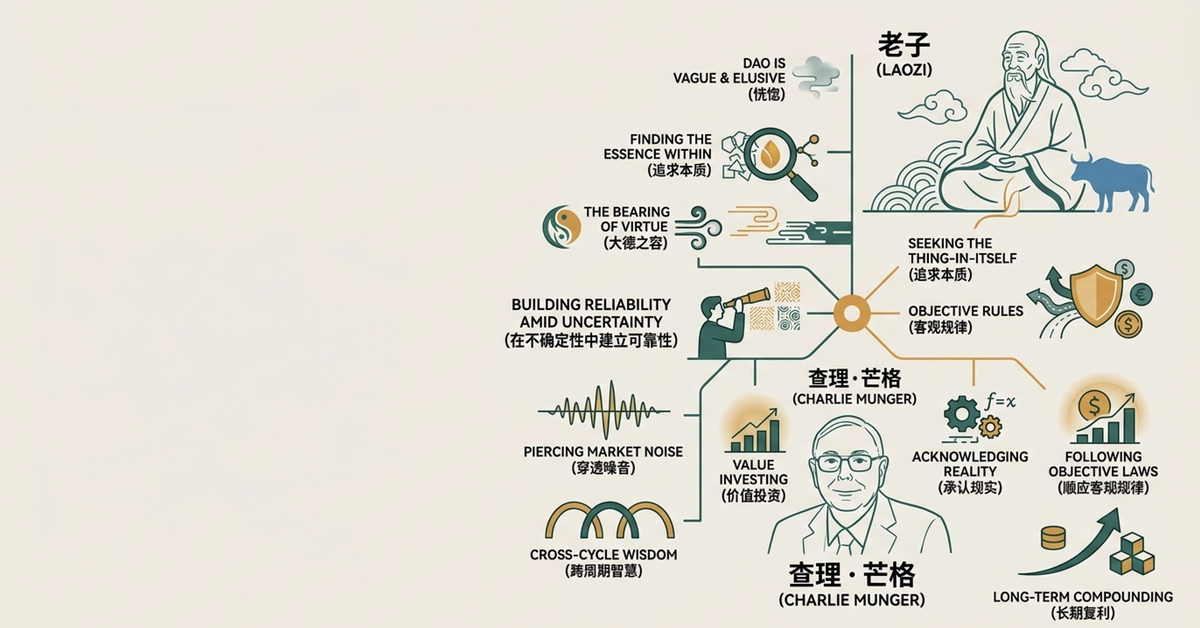
Laozi’s Dao, in Munger’s terms, is Worldly Wisdom. Laozi’s seeking the thing within the haze, in Munger’s terms, is finding intrinsic value in a volatile market. Laozi’s “its essence is supremely real; within it there is trustworthiness,” in Munger’s terms, is moats and trustworthy management. Laozi’s “from ancient times to the present, its name has not departed,” in Munger’s terms, is long‑term compounding that runs through cycles.
All his life Munger championed objectivity and a latticework of mental models. He believed investing is not about guessing the market’s short‑term moods, but about aligning with the underlying laws of business, economics, psychology—even physics.
Munger often said: Acknowledge reality, even if you don’t like it. That is precisely “following only the Dao”: don’t fight objective law; make it your sole decision rule.
In Munger’s view, the market’s day‑to‑day swings are “vague and elusive,” full of noise, irrationality, panic, and mania. Speculators get lost in the hazy curves, while value investors pierce the fog to see the image and the thing behind it—namely, a company’s intrinsic value, its moat, and its real cash flows. However blurry the stock price, the essence of a good business doesn’t change.
Munger prized management integrity, demanded rigorous financial analysis, stripped away glossy reporting, and sought a company’s truest earning power.
That is the Dao at its core. Munger believed human greed and fear—and the sound rules of business—have never changed. Because he held to wisdom that stands the test of time, he could, over an investing life spanning most of a century, see through the rise and fall of countless business models—“to behold the beginnings of the many”—and in the long river of time earn money from the eighth wonder of the world: compound interest.
Whether it is the immortal who rode a blue ox out through Hangu Pass more than two millennia ago, or the Western investing master born in Omaha who loved peanut brittle—when human wisdom reaches its heights, the world they see is the same: they do not chase the fleeting spray on the surface; they sink their roots into the enduring ocean current deep below.
“孔德之容,惟道是从。道之为物,惟恍惟惚。惚兮恍兮,其中有象;恍兮惚兮,其中有物。窈兮冥兮,其中有精;其精甚真,其中有信。自今及古,其名不去,以阅众甫。吾何以知众甫之状哉?以此。”
老子所说的道,就如这事物的本质一样,所见之处仅仅是他的外形。和这先生告诉我的道理一样,是蕴藏在其身后的本质。老子多说的大德在先生这里更通俗,这是事物运行的客观规律、商业的底层逻辑、人性的根本面目。
孔是大,容是包容。成年之后你会发现真正的高手并没有固定的套路和花里胡哨的技巧,他们更能顺应规律。
为什么大道理大家都懂,却过不好这一生?因为那些真正的规律(道)从来不是写在纸上的硬性公式。商业风口、人际关系、宏观经济看上去总是恍恍惚惚的,投资之前仿佛什么都能赚钱,买股票前都是豪言壮语。然而世界的常态本就是模糊的,人最大的痛苦的就是来自于想要确定性而不得。
慢慢回味后才知道老子教我们的方法不仅是理解确定性,而是提高对不确定性的承载力,让可控的更可控、不可控的更不可怕。
钱钟书的围城中写的方鸿渐,从留学、求职和恋爱中不断寻找一个稳的答案,然而答案却在不断地变形。一旦方鸿渐尝试把婚姻、职位当做永恒的护城河,却发现河并不宽敞,围墙也并不结实。围与不围,都是误把短期的误判为长期的安稳。
于是乎城里的人想出去,城外的人想进来。
所以,寻找确定性只是一种善良的自我安慰。这里的道不在天外,而在制度与社群之中:一个人要想在不确定中站稳,不仅要有节制与自持,更要有分散风险的能力。
不要把全部希望押在一份工作、一次投资、一个人感情上。
小说令人心碎,却也如同老子的话一般逼人清醒:个人的勤奋需要建立在更稳的结构/规律上,才有力量顺势而为。缺了这层认知,过度的内耗不过是在与系统性的波动硬碰硬,终究白了少年头罢了。
所以,规律不会消失,太阳底下并没有新鲜事。
康德把世界分为现象界(人们感官看到、经验到的世界)和物自体(事物原本的真实面貌),他认为人能看到现象,而物自体不是被直观认识的。当然老子比康德乐观一些,通过惟道是从的修行,是可以把握这个“精”,也就是他所说的道的。
不管现在短视频多火,不管当前 AI 怎么发达,人性的贪嗔痴没变,商业中创造价值才有回报的逻辑没变。有空多读经典,多总结底层规律,用这套不变的算法去应对人生的各种突发状况,方能从容。
在模糊中寻找现象,用小步落地成事,提炼可复用的关键嗲,通过反复验证建立可靠,由此顺随事物之道。
老子的道,在芒格那里叫 Worldly Wisdom。 老子的恍惚中求物,在芒格那里叫在波动的市场中寻找内在价值。 老子的其精甚真,其中有信,在芒格那里叫护城河与可靠的管理层。 老子的自古及今,其名不去,在芒格那里叫穿越周期的长期复利。
芒格一生极度推崇客观性和多元思维模型。他认为,投资不是去猜测市场的短期情绪,而是要去顺应商业、经济学、心理学甚至物理学的底层规律。 芒格常说:要承认现实,哪怕你不喜欢它。这正是惟道是从,不与客观规律作对,而是将其作为决策的唯一准则。 芒格说股市的日常波动就是惟恍惟惚的,充满了噪音、非理性、恐慌与狂热。投机者迷失在恍惚的曲线里,而价值投资者则能穿透迷雾,无非看到背后的象和物。也就是企业的内在价值、护城河以及真实的现金流。不管股价怎么恍惚,好生意的本质是不变的。 芒格看重企业管理层的诚信,要求进行严苛的财务分析,剥去华丽的财报包装,寻找企业最真实的盈利能力。 这就是道的核心,芒格认为人类的贪婪、恐惧、以及优秀的商业法则从未改变。也是因为芒格掌握这些经得起时间考验的普世智慧,才能在长达大半个世纪的投资生涯中,看透各种商业模式的兴衰起落/以阅众甫,在时间长河中赚取那世界第八大奇迹—复利的钱。
无论是两千多年前骑青牛出函谷关的仙人,或是曾生于奥马哈爱吃花生糖的西方投资大师,当人类的智慧达到顶峰时,他们眼中的世界是一样的:不去追逐表面那些转瞬即逝的浪花,而是深深地扎根于海底那股永恒的洋流之中。
讨论
登录后可评论、点赞、引用回复。